
The Right Candidate Doesn’t Always Use the Right Keywords
Two resumes land in your inbox for a Customer Success role.
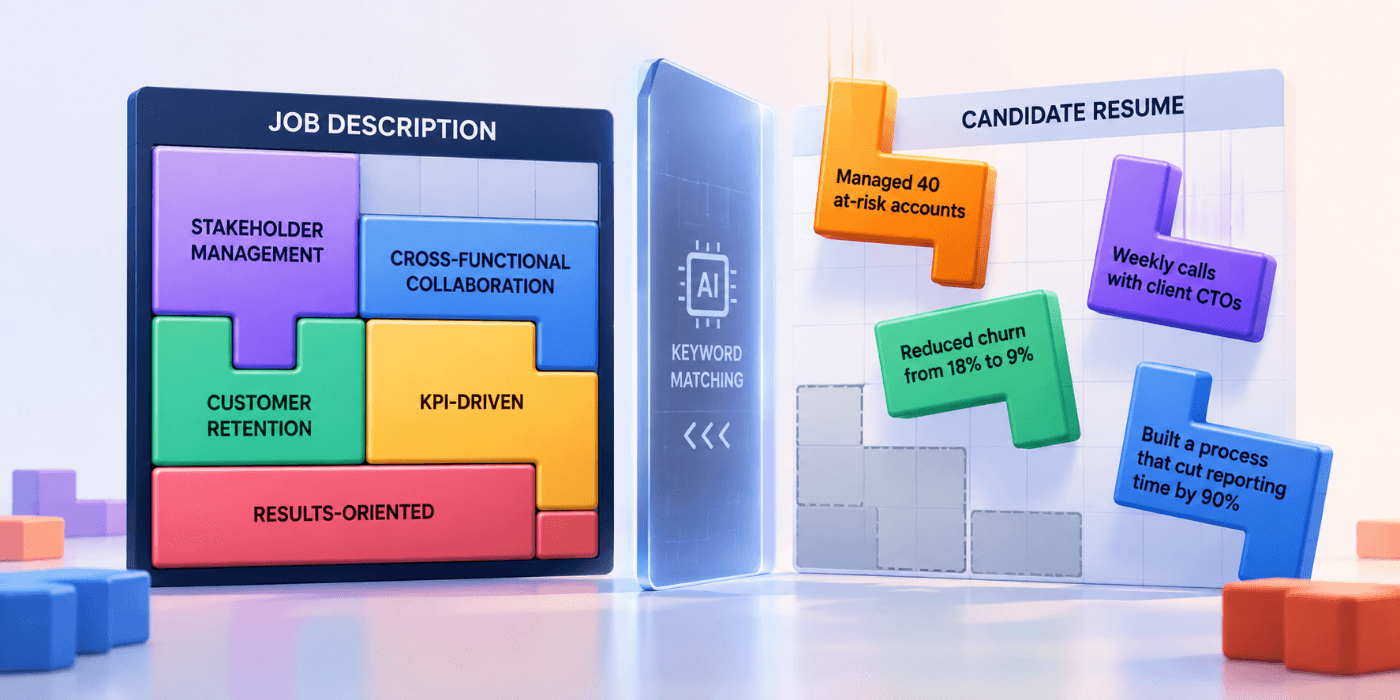
Candidate A lists: stakeholder management, cross-functional collaboration, KPI-driven, results-oriented.
Candidate B writes: Took over 40 at-risk accounts. Ran weekly calls with client CTOs. Brought churn from 18% to 9% in two quarters.
Now imagine your screening process ranks Candidate A higher.
Why?
Because Candidate A used four phrases that appeared in the job description. Candidate B used almost none of them. But if you were the hiring manager, which candidate would you want to understand better?
"The problem with resume screening isn't automation. It's confusing vocabulary with evidence."
Why Keyword Screening Feels Safe
Keyword screening became popular for understandable reasons.
Recruiters have too many resumes and too little time.
A keyword gives you something measurable. A phrase appears in a resume, and the system can count it. The candidate gets a match. The recruiter gets a shortlist.
It's fast. It's consistent. And it sounds objective.
You can even explain the process easily:
"We screened candidates against the requirements in the job description."
But there's a hidden assumption underneath that process:
Candidates will describe their experience using the same vocabulary that employers use in their job descriptions.
That's often not true. And the gap between those two vocabularies is where good candidates can disappear.
A Skill Doesn't Always Come With the Right Label
Consider "stakeholder management."
A candidate might write:
"Managed relationships with 15 enterprise clients and handled escalations directly with their technology leadership teams."
They never wrote stakeholder management, but the evidence is there. Or consider "process improvement." A candidate might write:
"Built a Python script that reduced weekly report preparation from six hours to 30 minutes."
They never wrote process improvement. They demonstrated it. This distinction matters because a resume contains two very different kinds of information.
There are labels:
- Stakeholder management
- Leadership
- Communication
- Problem solving
- Data analysis
And there is evidence:
- What someone worked on
- What they owned
- Who they worked with
- What problems they solved
- What changed because of their work
- What results they produced
The label tells you what the candidate claims. The evidence gives you something to investigate.
Keywords Aren't the Enemy
It's important not to take this argument too far. Keywords are useful when the requirement itself depends on specific terminology.
If a role requires experience with a particular platform, programming language, enterprise tool, certification, or technical framework, the exact term can be highly relevant.
If you're hiring a Python developer, knowing whether the candidate has worked with Python matters.
If you're hiring someone who must use a specific enterprise platform, experience with that platform matters.
The problem begins when we use the same approach for capabilities that can be demonstrated in many different ways. "Stakeholder management" is not a software package.
Neither is "ownership."
Neither is "problem solving."
Neither is "leadership."
A candidate can demonstrate those capabilities without ever using those exact words. So the better question isn't:
"Did the candidate use the phrase?"
It's:
"Does the candidate's experience provide evidence of the capability?"
What Keyword Screening Can Miss
1. Vocabulary mismatch
Your job description says:
Stakeholder management
The candidate says:
"Handled client escalations and kept senior leadership updated."
The first phrase matches.
The second describes potentially relevant experience.
A system focused primarily on terminology may recognize the first and overlook the second.
2. Keyword stuffing
Candidates know that screening systems look for particular terms.
That creates an incentive to add those terms to a resume—even when the surrounding evidence is thin. A candidate can copy phrases from a job description in minutes.
But adding "stakeholder management" to a skills section doesn't tell you whether the person has actually managed stakeholders.
The more heavily screening rewards vocabulary, the more valuable vocabulary becomes That can shift the optimization problem from:
"Describe what you have done."
to:
"Describe yourself in the language the screening system wants to see."
3. Different professional vocabularies
Not every candidate has been taught how to write a corporate resume.
Someone who worked at a large organization may have been surrounded by formal competency frameworks and standardized job terminology. Someone from a smaller company may simply describe what they did. Someone changing careers may describe transferable experience using language from their previous field.
The underlying capabilities may overlap even when the vocabulary doesn't. That doesn't mean every candidate who uses plain language is qualified.
It means language style shouldn't become a substitute for evaluating the underlying experience.
Look at the Work, Not Just the Words
| Resume description | Keyword lens | Evidence lens |
|---|---|---|
| "Stakeholder management, cross-functional collaboration" | Strong terminology match | Claims, but limited evidence |
| "Handled escalations from our biggest 15 clients and briefed the VP weekly" | Potentially weak keyword match | Client ownership, senior stakeholders, recurring communication, scope |
| "Built a Python script that cut report preparation from 6 hours to 30 minutes" | May miss "automation" or "process improvement" | Technical initiative, process improvement, measurable impact |
The difference is subtle but important.
The keyword lens asks:
"How similar is this resume to the language of the job description?"
The evidence lens asks:
"What does this person's experience tell us about their ability to do the work?"
Those aren't the same question.
And the second question is usually closer to what a recruiter actually wants to know.
What Evidence Should Screening Look For?
A more useful screening process can examine several dimensions of the candidate's experience.
Projects and outcomes
A skill that appears in the context of actual work is more informative than a skill sitting in a list.
"Data analysis" is a claim.
"Analyzed customer usage data to identify the three behaviors most associated with churn" gives the claim context.
Scope and ownership
What did the candidate actually own?
How many customers?
How large a team?
How many users?
What level of stakeholders?
Did they lead the work, contribute to it, or support someone else?
Context changes the meaning of an experience.
Progression
A title alone tells you relatively little.
A description such as:
"Started managing five accounts and later took ownership of 40 enterprise accounts."
tells you something about how the candidate's responsibilities evolved.
Consistency
A resume might list "data analysis" as a skill.
But where does that skill appear in the candidate's actual experience?
If a capability is repeatedly claimed but never connected to any work, that is useful information too.
The goal isn't to automatically reject the candidate.
It's to identify what deserves further investigation.
This Is Where AI Can Help—but With an Important Boundary
Reading resumes for this kind of contextual evidence is time-consuming.
That's especially true when a recruiter is reviewing hundreds of resumes.
This is where AI can be useful.
Instead of simply counting phrases, an AI system can examine the relationship between the job requirement and the work described in the resume.
A candidate doesn't necessarily need to write:
"Stakeholder management."
Their experience may contain enough context for the system to identify potentially relevant evidence.
But there's an important boundary.
Inference is not proof.
Suppose a resume says:
"Worked closely with senior clients to resolve recurring issues and improve account relationships."
That may provide evidence relevant to stakeholder management.
But it doesn't establish everything you might want to know.
How difficult were the relationships?
How much responsibility did the candidate have?
Were they leading those conversations or supporting someone else?
What was the outcome?
Those are questions an interview can help answer.
So the right model isn't:
AI reads the resume → AI decides the candidate is qualified.
It's:
AI identifies relevant evidence → AI highlights what appears relevant and what remains unclear → human verifies it → human makes the hiring decision.
That distinction matters.
The purpose of AI screening shouldn't be to eliminate human judgment.
It should be to help humans spend more of their time exercising judgment where it actually matters.
What Recruiters Can Change This Week
1. Write job descriptions around outcomes
Compare:
"Strong communicator and fast learner."
with:
"Reduce churn among mid-market accounts by identifying risks early and coordinating resolution across customer-facing teams."
The second gives candidates—and screening systems—something meaningful to look for.
2. Separate terminology from capability
Ask which requirements genuinely require exact terminology.
If the answer is a particular technology, platform, certification, or tool, keywords can be useful.
If the requirement is leadership, ownership, communication, problem solving, or stakeholder management, look for evidence of the work.
3. Look at projects before skill lists
When reviewing a resume, don't stop at the skills section.
Ask:
"Where did this candidate actually use this skill?"
The answer may tell you more than the keyword itself.
4. Audit who your process rejects
Take a sample of rejected resumes and ask:
"Would any of these candidates have been worth a conversation?"
Then look at your recent successful hires.
Ask:
"If this person applied today using the resume they originally submitted, would our current screening process have recognized their relevant experience?"
These exercises can reveal blind spots surprisingly quickly.
Where SkillMoksha Fits
The underlying challenge is scale.
A recruiter may understand the value of contextual evidence, but reading hundreds of resumes that way takes significant time.
That creates a practical temptation to simplify the process.
Count the keywords.
Rank the matches.
Move on.
SkillMoksha is designed to help address that scale problem by looking beyond exact keyword repetition and examining the information contained in candidates' project and work descriptions against the requirements of the role.
That means a candidate doesn't necessarily have to use the exact terminology from the job description for their relevant experience to be surfaced.
At the same time, unclear information shouldn't become false certainty.
Where the resume doesn't provide enough evidence, the interview remains important.
That's the role AI should play in hiring:
Not making the decision for the recruiter, but helping the recruiter see relevant evidence faster and consistently.
The Question Worth Asking Your Hiring Team
The next time someone tells you that a candidate is a strong match because their resume contains the right keywords, ask one more question:
"What did they actually do that demonstrates the skill?"
And when a candidate doesn't use the expected terminology, ask the opposite:
"What evidence might we be missing because they described their experience differently?"
Because the best candidate may never have written "stakeholder management."
They may have spent the last three years doing it.