
Stop Testing LeetCode Recall. Test Engineering Judgment.
Imagine two candidates applying for the same software engineering role. Candidate A solves a difficult algorithm problem in 12 minutes. The solution is correct, efficient, and polished. Candidate B struggles with that puzzle. But give them a small API task and the picture changes: they read the existing code, add pagination, handle the empty-page case, make a sensible trade-off, and clearly explain why they chose one approach over another.
Which candidate has demonstrated more evidence about how they will actually work as an engineer? The answer isn't necessarily Candidate B. Algorithmic reasoning can genuinely matter, particularly in performance-critical systems, infrastructure, search, or data-heavy engineering. But that is precisely the point: the assessment should measure what the job requires.
"The question isn't whether developers can solve coding puzzles. It's whether the assessment produces useful evidence about the work they're actually being hired to do."
Why Algorithm Puzzles Became the Default
Timed coding puzzles have obvious advantages for hiring teams. Everyone receives the same question, everyone gets the same amount of time, and answers can be evaluated against a relatively clear standard. At high volume, that consistency is attractive because it makes technical screening easier to administer and compare.
Big technology companies also helped establish algorithmic interviews as a model for technical hiring. Over time, a useful assessment tool became something closer to a default. But standardization can create a hidden assumption: if someone performs well on a coding puzzle, they will perform well as an engineer.
That assumption deserves more scrutiny. Research on employee selection has continued to emphasize the value of job-specific methods such as structured interviews and work samples, alongside general cognitive ability measures. The lesson isn't that cognitive ability or algorithmic reasoning has no value. It's that hiring decisions are stronger when the assessment produces evidence relevant to the work itself.
Algorithm questions can therefore have a legitimate place in technical hiring. The problem is using them as the whole test, particularly when the role itself does not require candidates to routinely solve abstract algorithmic problems under severe time constraints.
What Does a Timed Puzzle Actually Measure?
A coding puzzle can reveal useful things. But it also captures signals that may have little to do with day-to-day engineering work. When a candidate is given an unfamiliar problem, a strict deadline, and no existing codebase to work with, the assessment is measuring more than their ability to build software.
1. Pattern Recognition and Recall
A candidate who has encountered a particular problem pattern before may recognize the solution quickly. Another candidate may have excellent engineering judgment but have never practiced that specific pattern. That doesn't make the first candidate's ability irrelevant. It means the test is partly measuring familiarity with the assessment format.
Interview data also suggests that technical interview performance can be surprisingly inconsistent. Research from interviewing.io, based on a large dataset of technical interviews, found substantial variation in how candidates performed across interviews and reported a strong relationship between practice interviews and performance. That is a useful reminder that preparation for the test itself can influence the signal.
2. Performance Under Artificial Pressure
A ticking clock changes behavior. That can be useful if the job itself regularly requires someone to reason under severe time pressure. But for many developers, day-to-day work looks different. They inspect documentation, read existing code, run tests, ask colleagues questions, try an approach, discover a problem, and revise it.
Research involving students and technical interviews has also found that being observed can substantially affect problem-solving performance. That research had a small sample, so it shouldn't be treated as definitive evidence about developer hiring. It does, however, illustrate an important point: the testing environment can affect the signal you're trying to measure.
3. Preparation Advantage
There is another uncomfortable question: how much of the score reflects preparation access? A candidate who has spent months practicing common interview patterns has an advantage over someone who has spent that same time building software.
Preparation is not inherently bad. Candidates should prepare for interviews. But hiring teams should be careful about mistaking being highly prepared for a particular assessment format for being highly capable at the underlying job. The more a hiring process rewards familiarity with a narrow set of puzzle patterns, the more important preparation for that format becomes.
Real Engineering Work Looks Different
Most software engineers aren't handed a blank editor and told to invent a graph algorithm from scratch in 30 minutes. They work with existing systems. They investigate bugs, add features, read unfamiliar code, handle messy inputs, think about failure modes, choose between several reasonable approaches, and explain decisions to colleagues. They also have to live with the consequences of those decisions after the code ships.
That doesn't mean algorithms don't matter. For an infrastructure engineer dealing with enormous datasets, algorithmic efficiency may be central to the job. In that case, asking how a system should handle a million records is highly relevant. The important distinction is job relevance: a coding assessment should provide evidence about the capabilities the role actually demands.
A Practical Alternative: 20 Minutes, Then Explain
One approach is to replace one abstract puzzle with a small, realistic task. Give the candidate a scoped problem drawn from the kind of work the role involves. That might mean fixing a bug in an existing code snippet, adding validation to a form handler, implementing pagination on an API endpoint, parsing messy input, or adding a small feature to an existing function.
Then ask the candidate to explain their choices. Why did they approach the problem this way? What edge cases did they consider? What would they change if they had another hour? What happens if the input is empty or unexpectedly large? These questions change the assessment because the reviewer isn't only looking at whether the code works; they're looking at whether the candidate understands the code they wrote.
That can reveal several useful signals, including code quality, edge-case awareness, communication, understanding of trade-offs, and the candidate's ability to recognize the limitations of their own solution. The goal isn't to reproduce an entire workday in 20 minutes. It is to create a small enough problem that meaningful engineering judgment can become observable.
The 20-minute constraint isn't magic. It simply creates a useful boundary. It's long enough to see how someone approaches a small engineering problem, while short enough to respect candidates' time. The follow-up matters just as much as the task because it allows the reviewer to probe the reasoning behind the implementation.
Timed Puzzle vs. Realistic Task
| Signal | Timed Puzzle | Realistic Task + Explanation |
|---|---|---|
| Problem-solving approach | Pattern recognition can have a significant influence | Shows how the candidate approaches a job-shaped problem |
| Code quality | Often secondary to reaching the solution within the time limit | Can be directly assessed as part of the task |
| Edge-case thinking | Often constrained by the puzzle format | Can be deliberately explored through follow-up questions |
| Communication | Often compressed by the clock | Can be explicitly assessed through explanation |
| Interview preparation | Practice with common patterns can provide an advantage | Places greater emphasis on applying skills to a new, relevant problem |
| Understanding of own code | May not be deeply tested | Can be probed directly through follow-up questions |
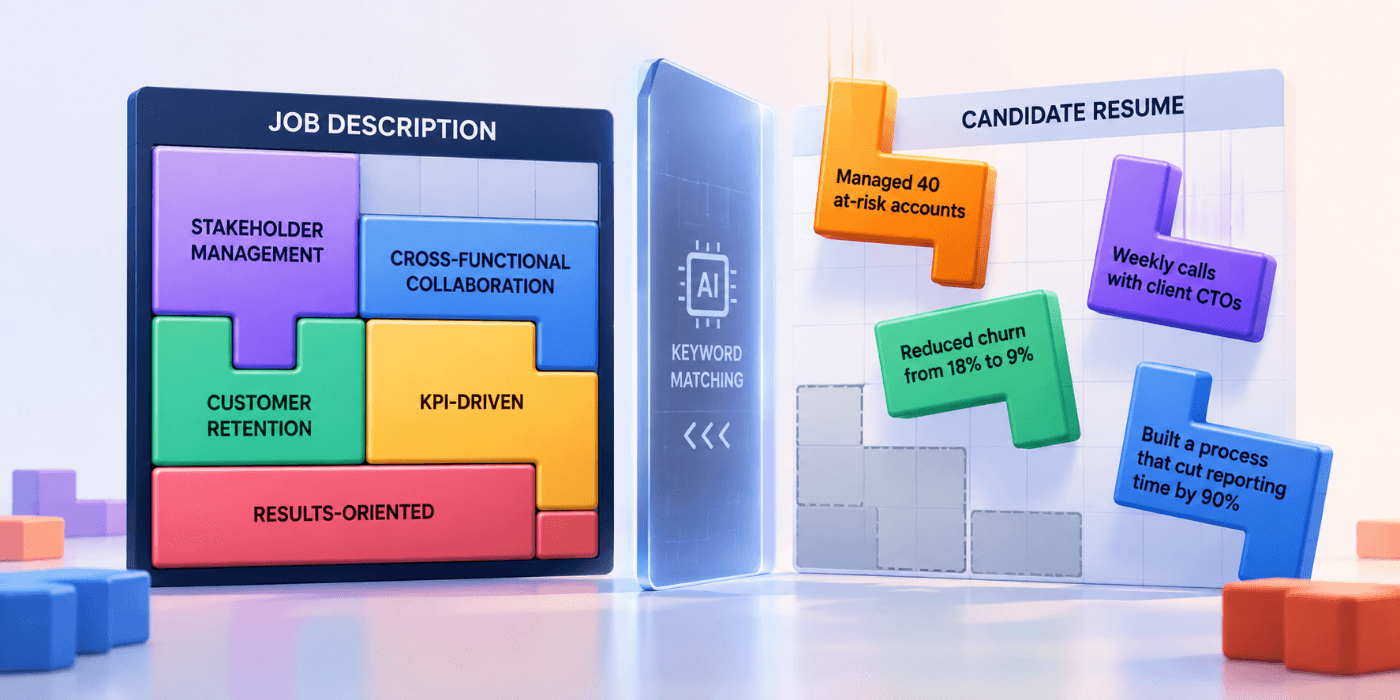
The difference is subtle but important. The keyword lens in resume screening asks how similar a resume is to the language of a job description. In technical assessment, the equivalent mistake is asking how well a candidate performs against the format of a coding test rather than how well the test captures the work they will actually perform.
A realistic task isn't automatically a better assessment. It becomes more defensible when the task is relevant to the role, the evaluation criteria are explicit, and every candidate is assessed against the same dimensions.
But Isn't This More Subjective?
This is the strongest objection to realistic coding assessments. A puzzle is relatively easy to standardize. A realistic task can become subjective: "I liked this candidate's code more." That's not a good assessment system.
The answer isn't to pretend subjectivity doesn't exist. It's to structure the evaluation. Hiring teams can use a fixed rubric that covers correctness, code quality, edge-case awareness, and explanation. Reviewers should assess the same dimensions for every candidate rather than relying on an overall impression.
There is another consideration in modern software development: candidates may use AI coding assistants. That doesn't necessarily make realistic coding tasks useless. It makes the follow-up more important. A candidate who can explain why their implementation works, identify its limitations, and modify it when challenged provides different evidence from code that simply happens to pass the tests.
The goal isn't to ban AI assistance or pretend candidates work without tools. It is to make the assessment reflect the reality of modern development while still examining whether the candidate understands and can reason about the work they submit.
What Hiring Teams Can Change This Week
You don't need to redesign your entire hiring process. Start with one experiment: take one coding puzzle from your current assessment and replace it with a small task based on a real requirement from the role.
Add one mandatory explanation question and create a simple rubric covering correctness, clarity, edge cases, and reasoning. The scoring doesn't have to be complicated. What matters is that reviewers know what evidence they are looking for and candidates are evaluated against consistent criteria.
Then look back at your last few strong hires. Ask a simple question: Would this assessment have captured the qualities that made them strong engineers? If the answer is no, that may tell you more about your assessment process than another debate about which coding puzzle is hardest.
Where Skill Moksha Fits
This is the thinking behind a more job-shaped approach to technical assessment. Skill Moksha's coding assessment capabilities can be used to create tasks aligned with the requirements of a particular role, while capturing structured candidate evaluation alongside the coding exercise.
The goal isn't to remove human judgment from technical hiring. It's to give hiring teams better evidence to use when exercising that judgment. A task can reflect the actual requirements in the job description, a structured evaluation can make comparisons more consistent, and candidate reasoning can give reviewers context that a pass/fail coding score cannot provide on its own.
The technology should support the decision, not make the decision. Human approval remains an essential part of the process because no assessment, algorithm, or AI system can capture every dimension of an engineer's potential contribution.
The Question Worth Asking
Go back to the two candidates. One demonstrated that they could solve a familiar algorithmic problem under a clock. The other demonstrated how they approached a small engineering problem, handled an edge case, made a trade-off, and explained their reasoning. Both signals may matter, depending on the role and what the hiring team needs to assess.
But if you're hiring someone to build software, one question should always come first:
Is your coding test measuring the job—or measuring preparation for the test?