
Why Wait Weeks to Hire When AI Can Move Candidates Through the Process in a Day?
If reviewing a resume takes a few minutes, an interview takes about an hour, and even a coding assessment can be be completed in a couple of hours, why does hiring often stretch across weeks?
It is a question that most organizations never stop to ask.
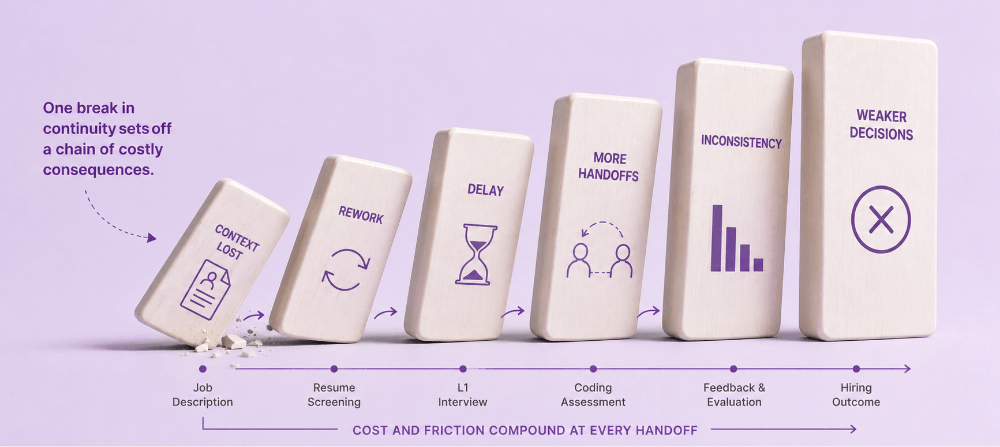
The answer is surprisingly simple. Hiring doesn't consume weeks of work—it accumulates weeks of waiting. Recruiters wait to screen resumes. Candidates wait for screening calls. Hiring managers wait for interview slots. Technical teams wait to conduct coding assessments. Everyone waits for interview feedback before the next stage can begin. Individually, these delays seem insignificant. Together, they create a recruitment process that moves at the pace of calendar coordination rather than business urgency.
"Hiring doesn't consume weeks of work—it accumulates weeks of waiting."
This is precisely the problem Artificial Intelligence is solving. AI is not making interviews shorter or coding assessments easier. It is removing the waiting between each stage of the recruitment process, allowing organizations to move qualified candidates forward without unnecessary delays while ensuring that people remain responsible for every hiring decision.
The Real Bottleneck in Recruitment
Most organizations believe recruitment takes time because evaluating candidates is difficult. In reality, evaluation is only a small part of the process.
Consider a typical hiring journey. Applications arrive and recruiters begin reviewing resumes. Once a shortlist is prepared, screening calls need to be scheduled around the availability of both recruiters and candidates. Successful candidates then wait for interview panels to find a common time. If the role requires technical evaluation, coding assessments must be arranged, supervised, and reviewed. Finally, interview feedback is collected from multiple stakeholders before a hiring manager is able to make a decision.
None of these activities are unreasonable. In fact, each serves an important purpose. The problem is that every stage introduces another waiting period. Although the actual evaluation of a candidate may only require a few hours of focused effort, the overall recruitment process becomes significantly longer because progress depends on multiple people becoming available at different times.
"The biggest bottleneck in recruitment isn't evaluation. It's coordination."
Once you begin looking at recruitment this way, the solution becomes much clearer. Organizations don't necessarily need people to work faster—they need the recruitment process to stop waiting for people before it can move forward.
How AI Removes the Waiting
An AI-assisted recruitment process follows the same objective as a traditional one: identify the best candidate for the role. The difference lies in how efficiently the process moves from one stage to the next.
Once recruiters define the job description and the evaluation criteria, AI can immediately assess incoming resumes against those predefined requirements. Candidates who satisfy the criteria can proceed to the next stage without waiting for manual resume reviews. Initial screening interactions can be conducted on demand instead of depending on recruiter availability. AI-assisted interviews allow candidates to participate whenever it is convenient for them rather than when interview panels can coordinate their calendars. Technical assessments can also be completed remotely, and structured evaluations are generated immediately after each stage is completed.
Instead of the recruitment process pausing after every milestone, it continues moving. Recruiters and hiring managers are no longer spending their time coordinating schedules or compiling evaluation reports. They are spending their time reviewing qualified candidates and making informed hiring decisions.
That shift alone can dramatically reduce the overall recruitment timeline, while preserving the quality of the hiring process.
Faster Recruitment Is Only the Beginning
The most visible advantage of AI-assisted recruitment is speed, but speed is only one part of the value it creates.
By reducing repetitive administrative work, recruiters are able to spend more time engaging with candidates and supporting hiring managers. Interviewers no longer need to conduct repetitive screening conversations for every applicant, allowing them to focus their attention on finalists who genuinely require deeper evaluation. Operational costs are also reduced because significantly less time is spent coordinating interviews, arranging assessments, collecting feedback, and managing recruitment logistics.
Perhaps more importantly, organizations become less likely to lose strong candidates simply because their recruitment process moved too slowly. Speed creates better business outcomes, but it also creates a better candidate experience.
Consistency Creates Better Hiring
Traditional interviews naturally introduce variation. Different interviewers ask different questions, focus on different competencies, and may arrive at different conclusions about equally capable candidates. Even experienced interviewers bring their own perspectives, preferences, and unconscious biases into the recruitment process.
AI introduces consistency without removing human judgment. Every resume is evaluated against the same recruiter-defined requirements. Every screening interaction follows the same evaluation framework. Every interview is conducted using consistent criteria. Every coding assessment is evaluated using the same standards. Recommendations are generated using the requirements established for the role rather than the preferences of individual interviewers.
This creates a recruitment process that is more structured, more transparent, and easier to audit. Consistency does not replace human experience—it strengthens it by ensuring that every candidate begins from the same starting point.
Human Judgment Remains Essential
One of the biggest misconceptions about AI in recruitment is that it replaces recruiters.
It should not.
Recruiters define the hiring criteria. Hiring managers determine what success looks like for the role. AI evaluates candidates against those predefined expectations and produces structured recommendations. At every stage—whether resume screening, candidate screening, interviews, or coding assessments—the recommendation can be reviewed, accepted, rejected, or overridden by a human.
"AI accelerates the process. People remain accountable for the outcome."
The final hiring decision always belongs to the people responsible for building the team. AI serves as an intelligent assistant, enabling faster, more informed, and more consistent hiring decisions while ensuring that accountability never leaves the organization.
How Skill Moksha Puts This Into Practice
This philosophy is exactly what Skill Moksha has been built around.
"Skill Moksha doesn't make hiring decisions faster by asking people to work harder. It makes hiring decisions faster by removing the waiting between them."
The platform begins with the recruiter. Hiring teams define the job description, establish the evaluation criteria, and configure the recruitment workflow. As applications are received, Skill Moksha evaluates every resume against those predefined requirements and recommends candidates who best match the role.
Qualified candidates can then complete AI-assisted screening interactions, interviews, and coding assessments without waiting for recruiter or interviewer availability. As each stage is completed, the platform generates structured evaluations that help recruiters and hiring managers make faster, more informed decisions.
Importantly, the platform is designed to assist—not replace—human judgment. Every recommendation remains transparent, every stage can be reviewed, and every recommendation can be accepted or overridden whenever required. Technology keeps the recruitment process moving. People remain in control.
Rethinking Recruitment
Organizations often look for ways to make recruiters work faster. A better question is whether recruiters should be spending their time waiting at all.
When technology removes unnecessary delays between hiring stages, recruitment becomes faster, more consistent, more transparent, and less expensive to operate. Recruiters spend less time coordinating calendars and more time evaluating people. Candidates spend less time waiting for updates and more time demonstrating their abilities. Hiring managers receive structured insights instead of fragmented feedback.
The future of recruitment is not about replacing people with Artificial Intelligence. It is about removing the waiting that has always slowed hiring down.
Because if evaluating a candidate takes only a few hours, perhaps recruitment never needed to take weeks in the first place.