
The Hidden Cost of Tool Sprawl in Recruitment
Recruiters don't have a shortage of recruitment technology. They have the opposite problem: too many tools that don't always understand what happened before.
There is a tool for resume screening. Another for video interviews. Another for coding assessments. Another for compliance. Another for scheduling and feedback.
Each tool may solve a specific problem well. But hiring isn't a collection of independent problems. It is one continuous decision-making process.
"The problem with recruitment technology isn't that recruiters lack tools. It's that they have too many tools that don't remember what happened before."
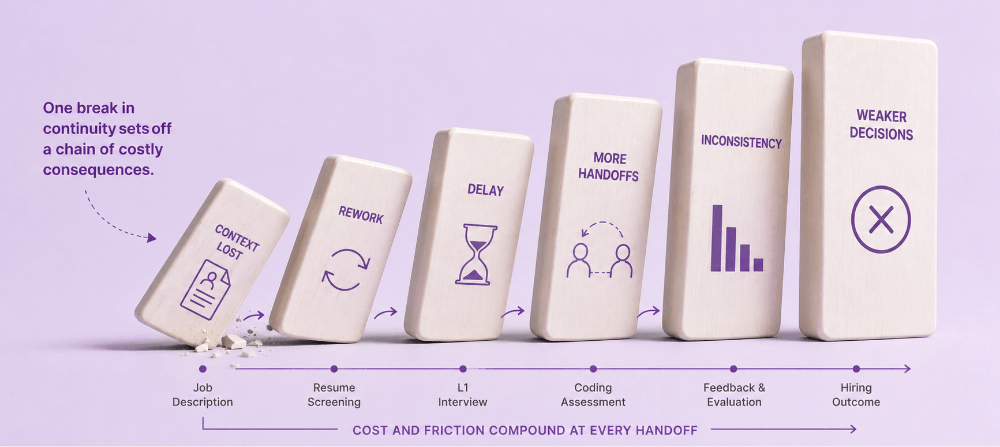
When candidates move from one platform to another, something important can disappear between the handoffs: context.
The resume may have been screened against a specific job description. The screening process may have identified a potential gap or an area that needed further validation. But when the candidate enters a separate interview platform, that context may no longer be available in a meaningful way.
The result is a fragmented hiring process in which every tool sees only one part of the candidate.
The Problem Isn't the Tools. It's the Handoffs.
Recruitment teams have adopted specialized technology for good reasons. A tool built specifically for resume screening can help recruiters process large numbers of applications. An interview platform can make candidate conversations easier to manage. A coding assessment platform can evaluate technical skills.
The problem begins when these systems operate independently.
Imagine a recruiter reviewing a candidate's resume against a job description. The candidate looks promising, but something is missing. Perhaps the resume doesn't provide enough evidence of a particular skill required for the role.
The recruiter decides the candidate is still worth moving forward to an L1 interview.
Now imagine that the interview is conducted in a completely separate system.
That system may know the candidate's name and resume. But does it understand why the candidate was moved forward? Does it know what the screening process found uncertain? Does it know which part of the candidate's background deserves deeper validation?
"Every handoff between recruitment tools creates another opportunity for context to fall through the cracks."
If the answer is no, the interview starts with a loss of context. The candidate is effectively being assessed again from scratch.
A Candidate Shouldn't Have to Start Over at Every Stage
A better recruitment process allows each stage to build on what came before it.
The job description establishes what the organization needs. Resume screening evaluates the candidate against those requirements and identifies strengths, gaps, or areas that may require further validation.
When that same context follows the candidate into the L1 interview, the interview can become more relevant.
If the resume suggests experience in a particular technology but doesn't provide enough evidence, the interview can investigate that specific area. If a requirement appears to be missing, the interview can test whether the candidate actually has the relevant capability.
The important point is not that the resume screening assessment is automatically correct.
The next stage should be able to validate it.
Instead of asking every candidate the same generic questions, the system can use what it already knows about the role and the candidate to conduct a more contextual assessment.
Integration Connects Tools. Continuity Connects the Assessment.
There is an important difference between integration and continuity.
Integration means information can move from one system to another. Continuity means the context behind that information remains available and useful throughout the candidate journey.
A recruiter shouldn't have to manually interpret the output of one platform and translate it into instructions for another. The recruitment system should understand the underlying hiring requirement and retain the relevant context as the candidate progresses.
That creates a connected assessment:
JD → Resume → Screening signals → L1 interview → Coding assessment → Structured feedback
Each stage contributes evidence to the same candidate evaluation.
This doesn't mean every stage needs to perform the same assessment. It means every stage understands what the organization is trying to evaluate and what has already been learned.
"Integration connects systems. Continuity connects the assessment."
More Context Means More Thorough Due Diligence
The value of continuity is not simply convenience.
When the same system understands the job description, the candidate's resume, the screening assessment, and the subsequent interview, it has a more complete picture of what is being evaluated.
That creates fewer opportunities for important information to be missed.
A recruiter is no longer forced to reconstruct the candidate's story by opening multiple platforms and comparing disconnected outputs. The assessment can remain connected from one stage to the next.
The result is more thorough due diligence. Not because AI is perfect, but because the evaluation has more context available at every stage.
Tool Sprawl Also Creates More Work for Recruiters
The cost of fragmented recruitment technology isn't limited to candidate assessment.
Recruiters become the connection layer between systems.
They move information between platforms, review different dashboards, collect feedback, reconcile assessment results, and reconstruct the candidate journey before a hiring decision can be made.
Every additional handoff creates another administrative task and another opportunity for information to be missed.
Recruiters should spend more time evaluating people and less time making disconnected recruitment tools work together.
Technology should reduce that administrative burden rather than adding another layer of coordination.
Continuity Doesn't Mean AI Is Always Right
There is an important caveat to this approach.
More context does not automatically mean better judgment.
An AI system can make an incorrect inference during resume screening. If that inference is blindly carried into the interview, the system could reinforce its own mistake.
That is why continuity should create a validation loop, not a confirmation loop.
If the system identifies a potential gap, the next stage should investigate it. If the candidate provides evidence that challenges the original assessment, that evidence should be part of the overall evaluation.
AI should help hiring teams gather better evidence and identify areas worth exploring. It should not turn an initial assessment into an unquestionable conclusion.
"Context should help AI ask better questions—not make its first answer unquestionable."
Human judgment remains essential. Recruiters and hiring managers must remain responsible for interpreting the evidence and making the final hiring decision.
How Skill Moksha Puts Continuity Into Practice
This is the thinking behind Skill Moksha.
The platform brings the recruitment workflow together from the creation of the job description through resume screening, L1 interviews, coding assessments, and structured candidate feedback.
"Skill Moksha isn't just bringing multiple recruitment tasks into one platform. It is bringing the context of the hiring process with them."
When the same system understands the job description and screens a candidate's resume, that context can remain available when the candidate moves into the interview stage. The interview doesn't have to begin with a blank slate.
The same principle extends to coding assessments and structured feedback. Each stage contributes to a broader understanding of the candidate rather than producing another isolated result.
This gives recruiters a more complete view of the candidate and reduces the likelihood that important information will slip through the cracks.
Importantly, Skill Moksha is designed to assist hiring decisions, not replace them. The technology can provide structured assessments and recommendations, while human decision-makers remain responsible for the final outcome.
Rethinking Recruitment Technology
Recruitment teams don't necessarily need another specialized tool.
They need technology that understands that hiring is one continuous process.
When a candidate moves from the job description to resume screening, from screening to an L1 interview, from the interview to a coding assessment, and finally to structured feedback, the context should move with them.
That can mean fewer information gaps, less manual coordination, more thorough due diligence, and a more complete evidence base for the people making the hiring decision.
The future of recruitment technology isn't necessarily about having more tools that each do one thing well.
It is about creating a hiring process in which every stage understands what came before it.
Because integration can connect your recruitment stack.
Continuity can connect your assessment.