
What Happens When AI Gets a Hiring Decision Wrong?
AI is transforming recruitment by making screening faster, more consistent, and more scalable. But recruiters still have a legitimate question: what happens when AI gets a candidate assessment wrong? With the right approach, those concerns don't have to stand in the way of AI adoption.
Recruitment teams are increasingly turning to AI for a simple reason: traditional hiring processes can be slow, repetitive, and difficult to scale.
Recruiters may have hundreds or even thousands of resumes to review. Candidates need to be screened against job requirements. Interviews need to be conducted. Assessments need to be evaluated. Feedback needs to be consolidated before a hiring decision can be made.
AI can significantly reduce the time spent on these tasks while bringing greater structure and consistency to candidate evaluation.
But there is a natural concern that comes with that adoption.
What if AI gets it wrong?
What if an unsuitable candidate gets through? What if a strong candidate gets filtered out? What if a recruiter doesn't understand why the AI reached its conclusion?
These are valid questions. But they are also questions that modern AI-powered recruitment systems can address through the way the hiring process is designed.
"The answer isn't to avoid AI in recruitment. It's to make sure the AI-assisted hiring process gives recruiters the evidence, flexibility, and control they need."
What If an Unqualified Candidate Gets Through?
One of the biggest concerns recruiters have about AI screening is the possibility of unsuitable candidates being recommended for the next stage.
But AI screening doesn't have to be a simple yes-or-no decision based on keywords.
A more comprehensive approach evaluates the candidate against the actual requirements of the role and provides a detailed assessment of where the candidate stands.
Instead of simply saying that a candidate is a match, the system can show which skills and requirements the candidate meets, where gaps exist, and what evidence supports the assessment.
This gives recruiters something much more valuable than a score: context.
The recruiter can then make an informed decision about whether the candidate should progress.
AI handles the scale and initial evaluation. The recruiter retains the ability to review the evidence.
What If a Good Candidate Gets Rejected?
The opposite concern is equally important.
A candidate may have the skills required for a role but describe their experience differently from the language used in the job description.
They may have transferable skills from another industry. They may have followed a non-traditional career path. Or they may possess valuable capabilities that aren't explicitly listed in the job description.
This is where simplistic keyword matching can become a problem.
A modern AI recruitment system can look beyond exact terminology and identify relevant skills and experience, while also highlighting other capabilities the candidate brings to the table.
That means a candidate isn't necessarily reduced to whether their resume contains the "right" words.
The system can surface the broader picture for the recruiter.
"The best candidates don't always have the most conventional resumes. AI should help recruiters see relevant capability, not just familiar terminology."
And importantly, an AI recommendation doesn't have to be the end of the conversation.
If the AI recommends rejecting a candidate, the recruiter can review the assessment and decide that the candidate deserves to move forward.
Human judgment remains part of the process.
What If the AI Score Doesn't Tell the Full Story?
A score can be useful for prioritizing candidates. But recruiters need more than a number when making hiring decisions.
Imagine seeing a candidate with an 82% match.
The natural question is: what does that 82% actually mean?
A useful AI recruitment system should answer that question.
The assessment should provide details about the candidate's relevant skills, the requirements they meet, the requirements they don't meet, and the evidence behind the assessment.
It can also highlight skills the candidate possesses that aren't explicitly mentioned in the job description.
This creates a much richer candidate profile than a simple pass-or-fail decision.
And as the candidate progresses through the hiring process, that information can continue to build.
The Candidate Assessment Should Get Better at Every Stage
Recruitment doesn't end with resume screening.
A candidate may move from resume evaluation to an interview, from an interview to a coding assessment, and through multiple stages before a final hiring decision is made.
Each stage creates an opportunity to gather more evidence.
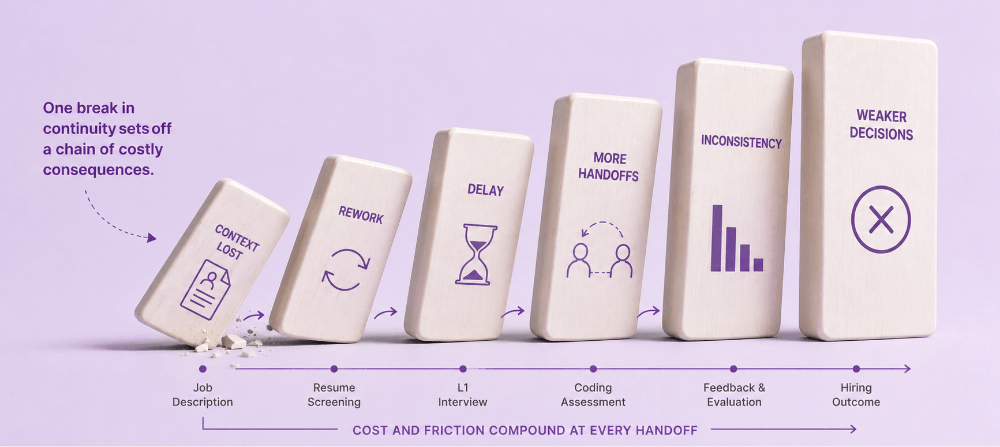
That evidence should not exist in isolation.
When the assessment from one stage is consolidated with what is learned at the next stage, recruiters can develop a much more complete understanding of the candidate.
For example, if resume screening identifies an area that needs further validation, the interview can provide an opportunity to explore it.
If the interview provides additional evidence about the candidate's capabilities, that information can become part of the overall assessment.
The result is not an AI decision based on one data point.
It is a progressively richer evaluation of the candidate.
"The more evidence you gather across the hiring process, the less a single screening decision has to carry on its own."
What If the Recruiter Disagrees With AI?
This is where human approval becomes particularly important.
AI should make recruitment easier for recruiters, not remove recruiters from the decision-making process.
If AI recommends selecting seven candidates and rejecting three, the recruiter should be able to review those recommendations and approve them.
But the recruiter should also be able to disagree.
A candidate rejected by AI can still be selected by the recruiter.
A candidate recommended by AI can still be rejected by the recruiter.
This flexibility means AI acts as an intelligent layer of support rather than an irreversible decision-maker.
The technology handles large-scale evaluation and presents structured evidence. The human remains responsible for the decision.
What About Different Types of Hiring?
Not every hiring situation requires the same screening approach.
Imagine a company hiring for a common role such as a Java developer with five years of experience.
If the market provides an abundant supply of candidates, recruiters may want a higher screening threshold so that only the strongest candidates progress to the next stage.
Now consider a highly specialized role where there may be only 40 or 50 relevant applications.
In that situation, the recruiter may want a lower threshold to avoid unnecessarily excluding candidates who have relevant but less conventional experience.
The important point is that the screening threshold can be aligned with the hiring context.
Recruiters can decide how selective they need to be based on the role, the available talent pool, and the number of candidates they need to evaluate.
AI doesn't have to force every hiring process into the same model.
It can give recruiters the flexibility to decide what makes sense for each search.
So, What Happens When AI Gets It Wrong?
The answer is simple: the recruiter doesn't have to accept the mistake.
That is the important distinction between AI-assisted recruitment and fully automated decision-making.
A well-designed AI recruitment process provides multiple opportunities to review and correct an assessment.
A candidate's resume can be reviewed in detail. Their skills can be assessed against the requirements of the role. Additional capabilities can be identified. Interview performance can add new evidence. Assessments can provide further validation.
And at every important stage, the human decision-maker can review what the AI has produced.
This means the goal isn't to build a system that claims it will never make a mistake.
The goal is to build a system where a mistake doesn't automatically become the final hiring decision.
AI Should Give Recruiters More Confidence, Not Less
The adoption of AI in recruitment is ultimately about improving the hiring process.
Companies want to hire faster. Recruiters want to spend less time on repetitive screening. Hiring teams want greater consistency. Candidates deserve a process that evaluates their capabilities fairly and transparently.
AI can help deliver those improvements.
The concerns around AI—false positives, false negatives, unconventional candidates, and over-reliance on automated scores—are real considerations.
But they don't have to become reasons to avoid AI.
They can become design considerations for building a better AI-assisted hiring process.
With detailed candidate evaluations, broader skills assessment, consolidated evidence across stages, configurable screening thresholds, and human approval, recruiters can use AI without surrendering control of the hiring decision.
That is the opportunity AI creates for recruitment.
"AI doesn't have to replace human judgment to transform recruitment. It can give recruiters better information, faster—and leave the final decision where it belongs."
How SkillMoksha Addresses These Concerns
This is precisely where SkillMoksha's approach to AI-powered recruitment becomes important.
SkillMoksha doesn't treat candidate screening as a single pass-or-fail decision.
Each candidate receives a detailed assessment that can be built upon as they move through the recruitment process.
The resume screening stage provides structured information about the candidate's fit, including the skills they have, the requirements they meet, potential gaps, and other capabilities that may be relevant even when they aren't explicitly listed in the job description.
When the candidate moves to the interview stage, that assessment can be supplemented with further evidence, including the interview evaluation and the interview recording.
The result is a consolidated view of the candidate rather than a series of disconnected decisions.
Most importantly, human approval remains part of the process.
Recruiters can review AI recommendations and make the final decision. They can move forward with a candidate the AI did not recommend, or choose not to progress someone the AI recommended.
This gives organizations the benefits of AI-powered scale and consistency while retaining the human judgment that hiring decisions require.
The question, therefore, isn't whether AI will ever make a mistake.
The more useful question is whether your recruitment system gives you the ability to see the evidence, review the recommendation, and make a better decision.
With the right approach, AI doesn't have to create another reason to worry about recruitment.
It can give recruiters greater confidence in the decisions they make.