
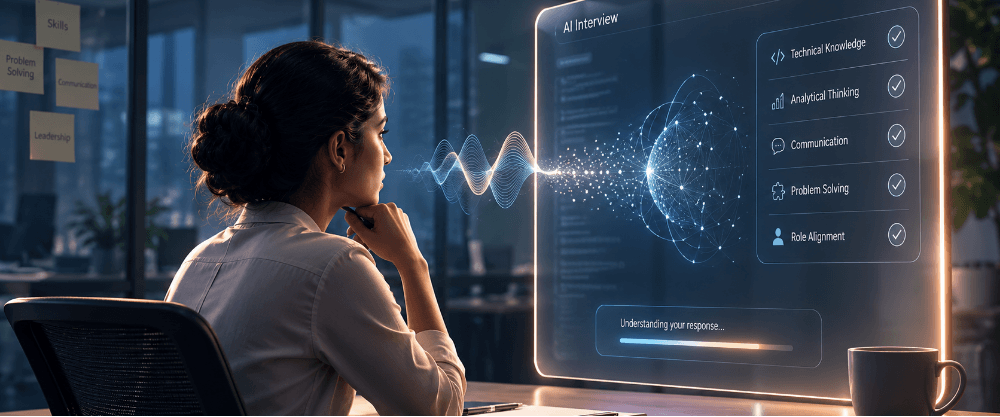
Are Your AI Interviews Making Candidates Feel Unheard?
AI interviews can make hiring faster and more consistent. But there is another question organizations need to ask: when a candidate finishes an AI interview, do they feel that they had a fair opportunity to communicate what they actually meant?
It is easy to assume that candidates are uncomfortable with AI because they would rather speak to a person.
But that assumption deserves more scrutiny.
What candidates are accustomed to matters. Someone who has spent years appearing for interviews conducted by people may naturally expect an interview to involve another human being sitting across from them, reacting to their answers, and providing subtle feedback through expressions, tone, gestures, and body language.
Someone entering the workforce today may have a very different frame of reference. They may already be familiar with recording video responses, completing online assessments, and participating in digital evaluation processes.
So the question may not be whether candidates are comfortable with AI.
The more important question is whether the AI interview gives them enough clarity and control to feel that they are being fairly assessed.
"AI interviews don't need to feel human. They need to make candidates feel understood and in control."
Familiarity Changes the Interview Experience
Every candidate brings a set of expectations to an interview.
Those expectations are shaped by previous experiences. For candidates who have traditionally interviewed in person, an interview has a familiar pattern. They meet a recruiter or hiring manager, answer questions, observe reactions, adjust their responses, and use the flow of the conversation to understand how the interaction is progressing.
That experience creates a set of mental shortcuts for understanding what an interview is supposed to be.
AI can disrupt those expectations.
But disruption does not necessarily mean rejection.
In practice, candidates can become comfortable with an AI interview quite quickly. The initial uncertainty can disappear once they understand the interaction and get into the flow of answering questions.
This is important because it suggests that the biggest challenge may not be making AI feel like a person.
It may be making the experience understandable enough that candidates know how to participate in it.
The Missing Feedback Loop
A human interviewer provides feedback constantly, even when they aren't consciously trying to.
A candidate might see that the interviewer looks confused and decide to explain something differently. They might notice enthusiasm in the interviewer's tone and understand that a particular answer was useful. They might see a nod and know that they can continue.
Much of this communication is implicit.
It is part of how people navigate conversations.
AI interviews are different. Candidates do not necessarily receive the same visual, tonal, or behavioural signals that they have learned to rely on during human conversations.
That can create uncertainty.
The candidate may wonder whether the answer was understood. They may wonder whether they should elaborate. They may wonder whether a follow-up question means their previous answer was inadequate.
The important point is not whether the AI actually understood the answer.
The important point is whether the candidate feels that they have been understood.
"When candidates don't receive the feedback they are accustomed to, uncertainty can replace confidence."
Control Matters More Than Imitating a Human
The obvious response might be to make AI behave more like a human interviewer.
But that may not be necessary.
The goal of an AI interview should not be to convince candidates that they are talking to a person. It should be to make the assessment process transparent and predictable.
Candidates should know what is happening, what is expected from them, and what they can do if they believe they have not communicated themselves properly.
This is closely connected to a fundamental principle of good interface design: people want to feel that they remain in control of the interaction.
That principle matters in recruitment because an interview is not simply an interaction with software. It is an evaluation that can influence someone's career.
The candidate needs confidence that a moment of uncertainty will not automatically become a permanent disadvantage.
Give Candidates a Chance to Clarify
Consider a simple situation.
A candidate answers a question and immediately realizes that the answer did not communicate what they intended to say.
In a conversation with a human interviewer, they can naturally respond:
"Actually, let me explain that differently."
Or:
"I don't think I answered that properly. Can I clarify?"
That ability to recover is an important part of normal human conversation.
AI interviews should explicitly make that possibility clear.
Candidates should know that they can clarify, correct, or expand an answer if they believe they have not expressed themselves properly.
This does not mean giving candidates unlimited attempts to manufacture the perfect answer. It does not mean removing the challenge of an interview.
It means ensuring that a candidate does not leave the interview believing they were penalized simply because they failed to communicate what they actually meant.
"Candidate control doesn't mean unlimited retries. It means giving candidates a fair opportunity to make themselves understood."
A Follow-Up Question Shouldn't Create More Anxiety
Follow-up questions are an important part of any good interview.
But in an AI interview, a candidate may interpret a follow-up differently.
If the candidate cannot see an interviewer's reaction, they may not know why the follow-up was asked. They could interpret it as evidence that their previous answer was wrong, incomplete, or poorly received.
The AI may have perfectly valid reasons for asking the next question. But the candidate does not necessarily know those reasons.
This is where transparency becomes important.
The interview experience should give candidates enough context to understand the interaction without revealing or compromising the evaluation itself.
The objective is not to tell candidates what the AI thinks about every answer. It is to prevent unnecessary uncertainty about what the candidate is allowed to do next.
Fairness Also Means Consistency
There is another dimension to the question of AI versus human interviews.
It may sound more candidate-friendly to offer candidates a choice between an AI interview and a human interview.
But that can create a different fairness problem.
Human interviews require interviewer availability. They take time to schedule and coordinate. AI interviews can potentially be completed when candidates are ready, without waiting for several people to find a common time.
If one candidate completes an interview today while another waits several days for a human interviewer, the two candidates are no longer moving through the same process.
The candidate waiting for the human interview could be disadvantaged simply because of the format they were given.
For that reason, consistency matters.
If an organization adopts AI interviewing, the objective should not simply be to provide a faster alternative. It should be to create a consistent assessment process in which candidates are evaluated against the same requirements and standards.
And consistency should never mean removing human accountability.
AI Assists. Humans Remain Accountable.
AI should not become the final decision-maker simply because it can process candidates faster.
The role of AI is to assist the recruitment process: to help evaluate candidates against defined requirements, conduct structured interactions, organize information, and generate useful assessments.
Recruiters and hiring managers remain responsible for determining what the organization needs and deciding who should ultimately be hired.
"AI can accelerate an assessment. It should never remove human accountability for the hiring decision."
This distinction is particularly important when discussing candidate experience.
A candidate should not have to choose between efficiency and fairness. Organizations should be able to use technology to move faster while still giving candidates a transparent and respectful assessment experience.
Don't Guess What Candidates Fear. Measure It.
There is one more principle that organizations should keep in mind.
It is tempting to make broad statements about what different candidates think about AI.
Younger candidates prefer AI.
Older candidates distrust it.
Candidates are afraid that AI will judge them unfairly.
Some of these observations may turn out to be true in particular situations. But without data, they remain assumptions.
Good AI recruitment should be evidence-driven.
Organizations should ask candidates about their experience. Did they understand the process? Did they feel comfortable? Did they feel they had enough opportunity to explain themselves? Did they believe the assessment was fair?
Those answers can tell us much more than assumptions about what candidates supposedly think.
How Skill Moksha Approaches AI Interviews
This is the thinking behind the way Skill Moksha approaches AI-powered recruitment.
"The goal isn't to make AI pretend to be human. The goal is to make the assessment fair, transparent, and easier for candidates to navigate."
AI-powered interviews can help organizations reduce delays, conduct structured candidate interactions, and create more consistent evaluations. But technology should not come at the expense of the candidate's ability to communicate effectively.
Candidates should understand the process. They should know that they can clarify or correct themselves. They should not have to guess whether a follow-up question means they have failed. And they should have confidence that the technology is assisting the assessment rather than making an irreversible judgment about them.
At the same time, the final hiring decision remains subject to human approval.
That balance matters.
The Better Question for AI Recruitment
The debate around AI interviews often starts with the wrong question.
"Will candidates prefer talking to a machine instead of a person?"
We don't necessarily need to answer that question to design a better interview.
A more useful question is:
Does the candidate feel that they had a fair opportunity to communicate who they are and what they can do?
If the answer is yes, AI does not need to imitate every characteristic of a human interviewer.
It needs to provide clarity where human conversations naturally provide feedback. It needs to give candidates reasonable control over the interaction. It needs to allow them to make themselves understood. And it needs to operate within a process where people remain accountable for the final decision.
That is how AI can make hiring faster without making it less fair.
Because the future of AI interviewing isn't about making candidates believe they're talking to a human.
It's about making sure they never finish the interview wondering whether they were heard.