

When organizations discuss hiring challenges, the conversation usually focuses on interviews. How many rounds should we conduct? How do we identify the best candidates? How do we improve assessments? These are important questions, but they often distract from a more fundamental problem.
Most companies are not losing candidates during interviews. They are losing candidates while candidates are waiting for interviews. This distinction matters because it changes how organizations think about time-to-hire and where they focus their improvement efforts.
The Real Cost of Slow Hiring
A vacant position is more than an HR problem. For business leaders, it often means delayed projects, increased workload for existing teams, reduced productivity, and missed opportunities. The longer a position remains open, the greater the impact on business performance.
There is another cost that is often overlooked. Candidates do not pause their job search while waiting for your organization to make progress.
In the Indian job market especially, candidates frequently apply to multiple organizations simultaneously. A candidate serving a notice period may participate in several interview processes at the same time.
If your hiring process takes too long, there is a good chance that a strong candidate will receive and accept another offer before you are ready to make a decision.
In many cases, organizations do not reject candidates. They simply move too slowly to hire them.
Why Hiring Takes Longer Than It Should
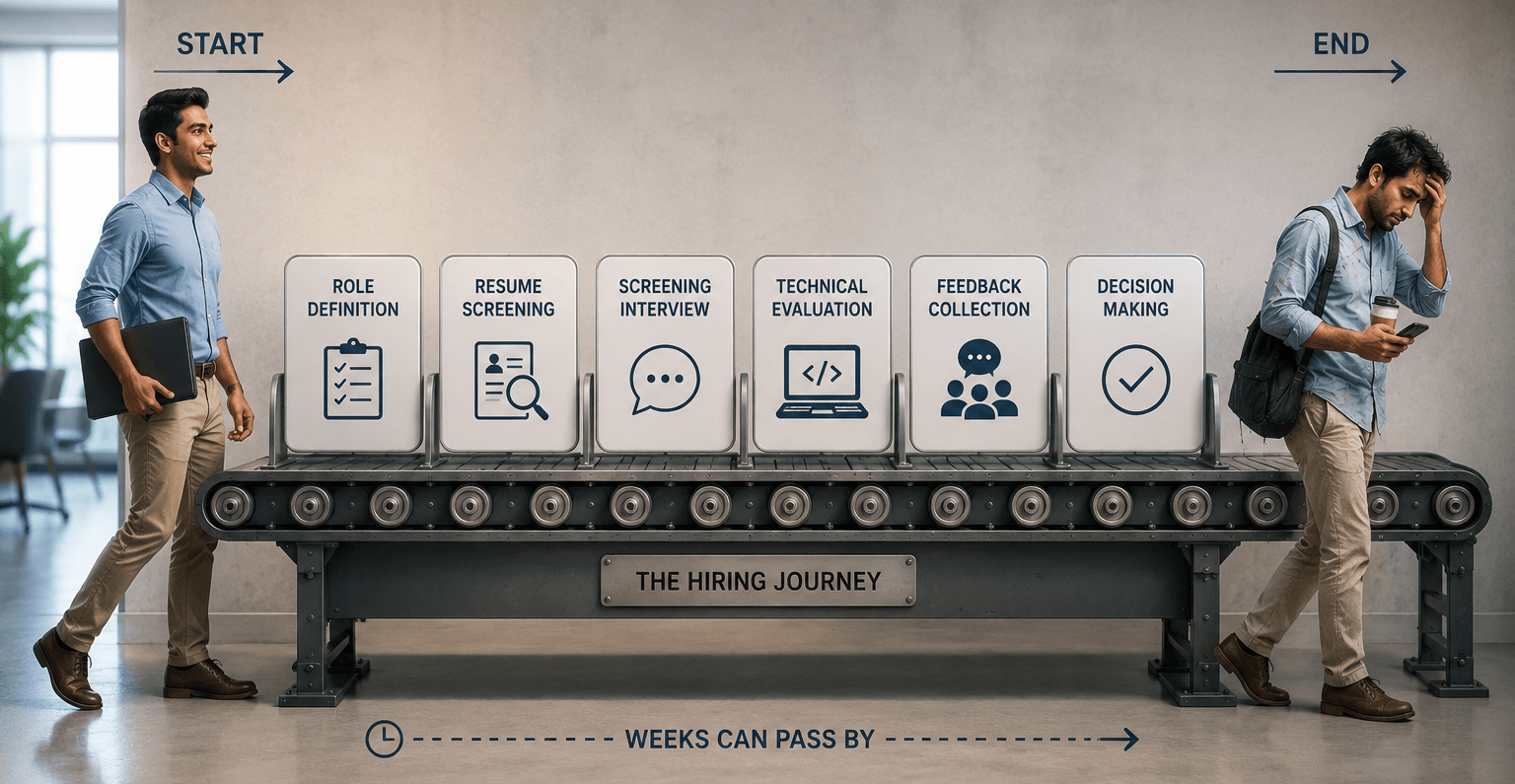
There is rarely a single cause behind a high time-to-hire. Delays accumulate across multiple stages.
The process begins with defining the role itself. If job requirements are unclear, organizations attract unsuitable candidates and create additional screening work.
Next comes resume screening. Recruiters and hiring managers often spend significant time reviewing applications, identifying relevant candidates, and shortlisting resumes.
Then come screening interviews, scheduling conversations, technical evaluations, feedback collection, and decision-making. Each step adds time.
Individually, these delays may seem small. Collectively, they can extend hiring cycles by weeks.
The Biggest Bottleneck Is Waiting

Organizations often assume interviews consume the most time. In reality, waiting frequently consumes more time than interviewing.
Candidates wait for resumes to be reviewed. They wait for interview invitations. They wait for interview slots to become available. They wait for feedback. They wait for decisions.
One of the biggest sources of delay is interview scheduling. Traditional hiring requires finding a time that works for both the candidate and the interviewer. Busy calendars, competing priorities, and scheduling conflicts can easily add days or weeks to the process.
During this waiting period, candidates continue exploring other opportunities. Every additional delay increases the risk of losing qualified talent.
What Should Be Automated and What Should Not
Discussions about AI in recruitment often become polarized. Some people believe AI should transform hiring completely. Others believe AI should play no role at all.
Neither position reflects how most organizations can benefit from technology.
The better question is not whether AI should participate in hiring. The better question is where AI creates the most value.
Administrative and repetitive activities are strong candidates for automation. These include:
- Resume screening
- Candidate shortlisting
- Initial candidate assessments
- Screening interviews
- Routine candidate communication
These activities consume time but do not necessarily require human judgment at every step. By automating them, organizations can move candidates through the hiring process more efficiently.
However, some responsibilities should remain firmly in human hands:
- Final hiring decisions
- Salary negotiations
- Team-fit evaluations
- Contextual and exception-based judgments
Hiring is ultimately a decision about people. Technology can support that decision, but it should not replace it.
Remove Waiting, Not Rigor
One of the most common misconceptions in recruitment is that faster hiring means lower hiring quality.
The reality is that speed and quality are not opposites. A rigorous evaluation process can still be efficient.
The real opportunity lies in eliminating unnecessary delays rather than reducing evaluation standards.
Organizations should focus on removing administrative bottlenecks, reducing scheduling friction, accelerating candidate movement through the pipeline, and ensuring that qualified candidates are evaluated promptly.
Recruiters and hiring managers create the most value when they spend their time evaluating people, not coordinating calendars or reviewing hundreds of resumes manually.
The Companies That Win Talent Move Faster
The competition for talent is no longer just about compensation or employer brand. It is also about responsiveness.
Candidates increasingly expect organizations to communicate clearly, evaluate efficiently, and make decisions quickly.
The organizations that consistently attract and secure strong talent are often not the ones with the most complex hiring processes. They are the ones that remove unnecessary waiting.
Because candidates rarely leave during interviews. More often, they leave while waiting for them.