From Interview Practice to Interview Improvement: How AI Can Help Freshers Prepare Better
For students and freshers, preparing for an interview can be difficult for a simple reason: they often have little experience of being interviewed. They may know their subjects, have completed projects, participated in competitions, or developed valuable skills, but still struggle to communicate what they know with confidence.
Traditional interview preparation usually means reading common questions, preparing answers, watching interview videos, or participating in an occasional mock interview.
These methods can help.
But there is another important part of preparation: understanding where you need to improve, recognizing what you are already good at, and getting another opportunity to practice those areas.
This is where AI-powered interview practice can play an important role.
"For students and freshers, an AI interview shouldn't be the end of the assessment. It should be the beginning of improvement."
A Fresher's Interview Is Different
An experienced professional comes to an interview with a track record of professional experience.
A fresher usually does not.
There may be internships, academic projects, certifications, competitions, extracurricular activities, or other experiences to discuss, but the interviewer has considerably less professional history to evaluate.
That changes what an interview should try to uncover.
For a fresher, the objective should not simply be to judge whether the candidate is ready or not ready.
It should also be to identify what the student knows, how effectively they communicate, where they need development, and what strengths they may be able to build on.
Qualifications and communication skills become particularly important because the interview is often one of the first opportunities for a student to demonstrate how they can apply and communicate what they have learned.
That makes coaching and feedback an important part of the process.
AI Can Create a More Comfortable Practice Environment
Interviews can be intimidating, especially when students have limited experience with them.
A student may worry about giving the wrong answer, sounding inexperienced, struggling to explain a technical concept, or simply not appearing confident enough.
These concerns can affect how well the student performs.
AI can provide an additional environment where students can practice without the pressure of a real hiring interview.
They can answer questions, make mistakes, try again, and become more comfortable with the interview experience.
The advantage is not that AI is incapable of judgment or that human interviewers are necessarily uncomfortable to speak with.
The advantage is that AI can provide a repeatable practice environment where the student has the opportunity to work on their performance before the stakes are real.
That can be particularly useful for students who have had very few opportunities to experience a formal interview.
The Biggest Gaps Are Often Confidence and Communication
A student can have strong technical knowledge and still struggle in an interview.
They may know the answer but find it difficult to explain it.
They may have completed an impressive project but describe it without clearly explaining their contribution.
They may have good problem-solving ability but struggle to explain their reasoning.
Or they may simply lack the confidence that comes from having practiced interviews several times.
These are important gaps because knowing something and demonstrating that knowledge in an interview are not always the same thing.
AI interview practice can help make these gaps visible.
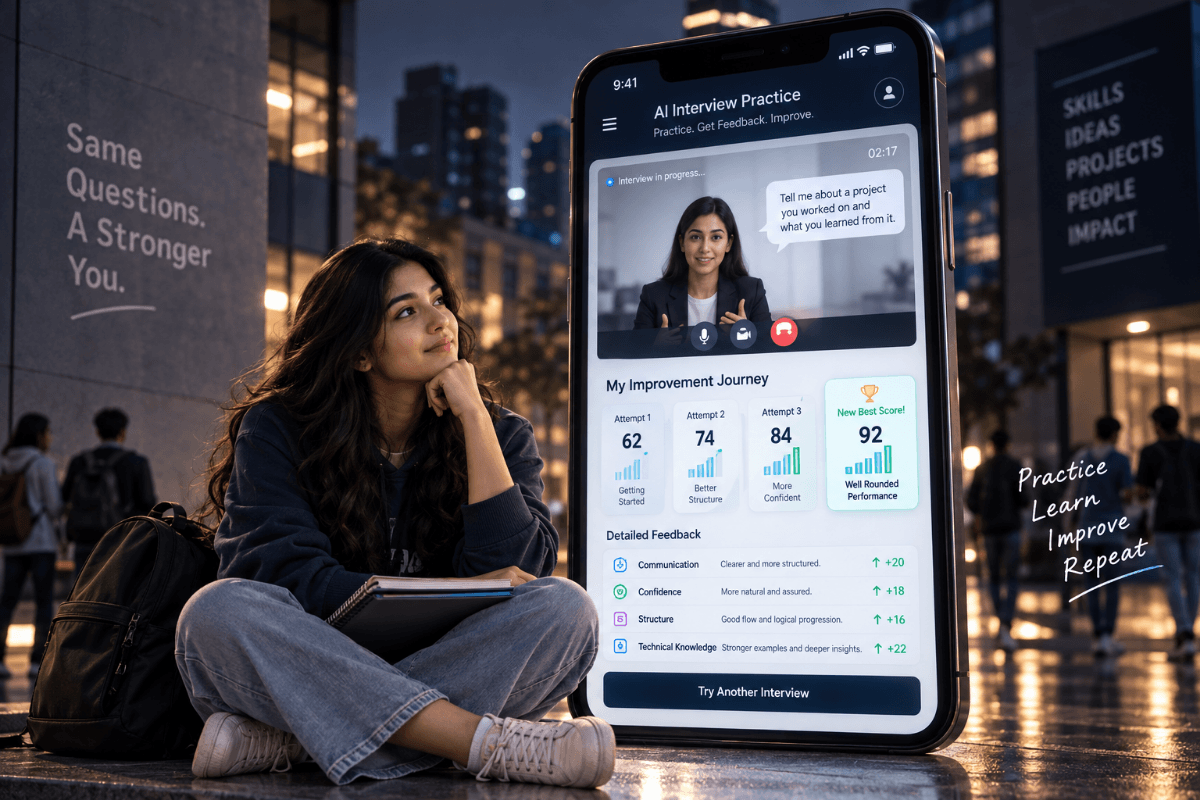
Instead of simply telling a student that they performed poorly, a useful assessment can help identify what happened during the interaction.
Was the answer unclear?
Was the response poorly structured?
Did the student understand the subject but fail to communicate it effectively?
Did they provide too little detail?
Did they struggle to explain their reasoning?
Identifying the specific problem is the first step toward improving it.
Feedback Is More Valuable Than a Score
One of the limitations of a simple interview score is that the score itself does not tell a student what to do next.
Consider the difference between:
"Communication: 6/10."
and:
"Your technical answer was correct, but the explanation was difficult to follow because the key point appeared late in your response. Try stating your main answer first and then explaining your reasoning."
The second type of feedback gives the student something they can actually work on.
This is where AI-powered interview preparation can become more than an assessment tool.
The purpose of feedback should be to help students understand their performance and identify specific actions they can take to improve.
The evaluation becomes useful when it leads to another attempt.
"The value of feedback is not in telling a student where they stand. It is in helping them understand how to move forward."
AI Can Help Students Discover Their Strengths
Identifying weaknesses is only one part of good interview preparation.
Students also need to understand what they are good at.
This can be surprisingly difficult.
A student may dismiss a college project because "everyone does projects."
Another student may not realize that their experience organizing a college event demonstrates planning and leadership.
A student who enjoys solving difficult technical problems may not recognize that their approach demonstrates strong analytical thinking.
Students do not always know which of their experiences or abilities are worth highlighting in an interview.
A well-designed AI interview can help surface these strengths by looking at how a student responds to different questions and situations.
The goal should not be for AI to declare that it has discovered a student's hidden talent.
Rather, it can help students recognize patterns in their own performance and identify strengths they may not have previously considered important.
That creates another important form of preparation.
Students are not only learning what they need to improve.
They are also learning what they can confidently bring to an interview.
Improvement Requires More Than One Interview
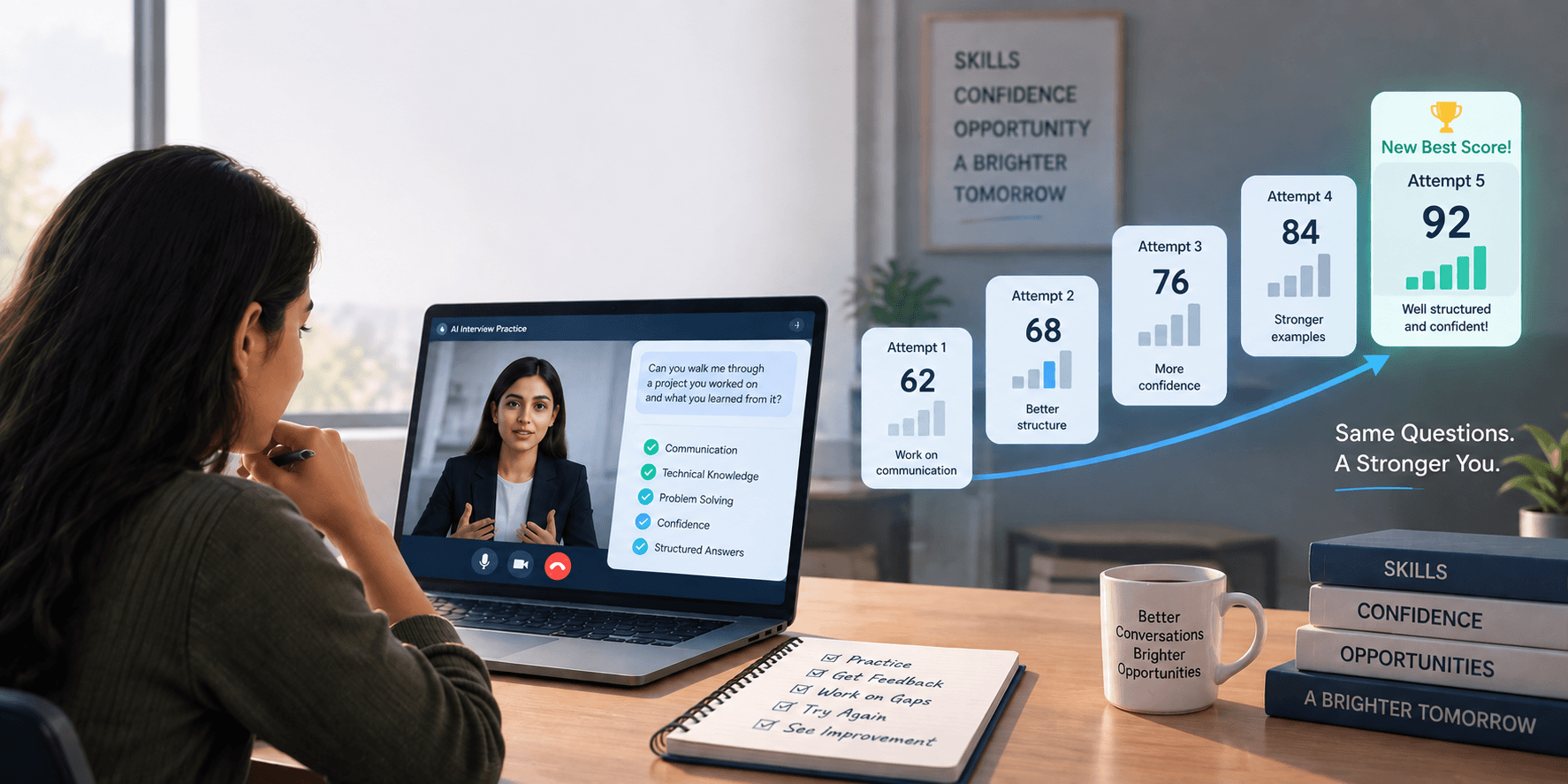
One of the biggest advantages of AI-powered interview practice is the ability to repeat the process.
A student takes an interview.
The system identifies areas that need improvement.
The student practices those areas.
Then the student takes another interview.
The process can continue.
Assess → Identify → Improve → Reassess
This loop is important because feedback has limited value if there is no opportunity to act on it.
Suppose a student consistently struggles to explain technical concepts clearly.
The first assessment identifies the issue.
The student then practices explaining technical concepts in a clearer and more structured way.
The next interview can assess whether the improvement has actually happened.
If it has not, the student gets another opportunity to work on it.
This makes interview preparation a process of development rather than a single practice event.
AI Can Stay Consistent Through Repeated Practice
There is another advantage to using AI for interview preparation.
AI does not get tired after conducting several practice interviews.
It can continue to focus on the assessment areas that have been defined and provide students with another opportunity to practice.
Human mentors, teachers, career coaches, and interviewers remain extremely valuable. They can provide context, encouragement, experience, and guidance that technology cannot replace.
But human attention is naturally limited.
A human interviewer may focus very deeply on one part of a conversation. Another may take a much broader view. Different people can also notice different things.
AI can provide a complementary layer of consistent, repeatable practice.
The point is not that AI is better than people.
The point is that students can benefit from having more opportunities to practice and receive structured feedback before they face a real interviewer.
From Assessment to Coaching
This is where AI interview preparation becomes fundamentally different from using AI simply to evaluate candidates.
When interviewing experienced professionals for a job, the organization may primarily want to assess whether the candidate meets the requirements of the role.
For students and freshers, there is another objective.
There is an opportunity to help the candidate improve.
That means the interview experience can include questions, assessment, feedback, targeted practice, and reassessment.
Instead of:
Interview → Score
the model becomes:
Interview → Feedback → Improvement → Reassessment
This shift matters because students are still developing their professional skills.
The purpose of the experience should not only be to tell them whether they are ready today.
It should help them become more ready tomorrow.
AI Does Not Replace Human Coaching
It is important not to turn this into an argument that AI can replace teachers, mentors, career coaches, or human interviewers.
It cannot and should not.
Human guidance remains important, particularly when students need context, encouragement, career advice, or help understanding situations that cannot be reduced to a structured assessment.
AI can instead provide another layer of support.
It can make frequent practice possible.
It can provide structured observations.
It can help students identify patterns in their performance.
And it can make reassessment easier.
The strongest model is therefore not AI versus human coaching.
It is AI-supported practice combined with human guidance where it adds the most value.
The Goal Is Not a Better Interview Score
It is tempting to measure interview preparation only through scores.
But the real objective is broader.
A student should finish the process with a better understanding of:
- What they know.
- What they need to improve.
- How effectively they communicate.
- Where their confidence needs development.
- What strengths they can bring into an interview.
- How they can demonstrate those strengths more effectively.
The score can be useful as one indicator.
But improvement is the bigger goal.
The Future of Interview Preparation Is Continuous
Students do not need another tool that simply tells them whether they passed or failed a mock interview.
They need opportunities to practice.
They need useful feedback.
They need to understand their gaps.
They need to recognize their strengths.
And they need another opportunity to try.
AI can help make that process more accessible and repeatable.
Instead of treating the interview as a one-time event, AI can help turn interview preparation into a continuous learning loop.
A student can practice today, identify a weakness, work on it, and return tomorrow to see whether they have improved.
That is a very different purpose for an AI interview.
For Freshers, the Interview Can Become Part of the Learning Process
The traditional view of an interview is simple.
The candidate answers questions.
The interviewer evaluates the candidate.
A decision is made.
For students and freshers, there is an opportunity to think about the process differently.
An interview can also become a learning experience.
It can help a student understand what they know, where they struggle, what they communicate well, and which strengths they should learn to articulate.
AI can support that process by making practice more accessible, feedback more structured, and reassessment more frequent.
"For students and freshers, an AI interview shouldn't be the end of the assessment. It should be the beginning of improvement."
The objective is not to make AI the final judge of a student's potential.
It is to give students more opportunities to prepare, learn, improve, and become better at demonstrating what they can do.
Because the best interview preparation is not the preparation that tells a student they are ready.
It is the preparation that helps them become ready.